Brazilian draughts rules: can you capture backwards? Do kings fly?
October 10, 2026
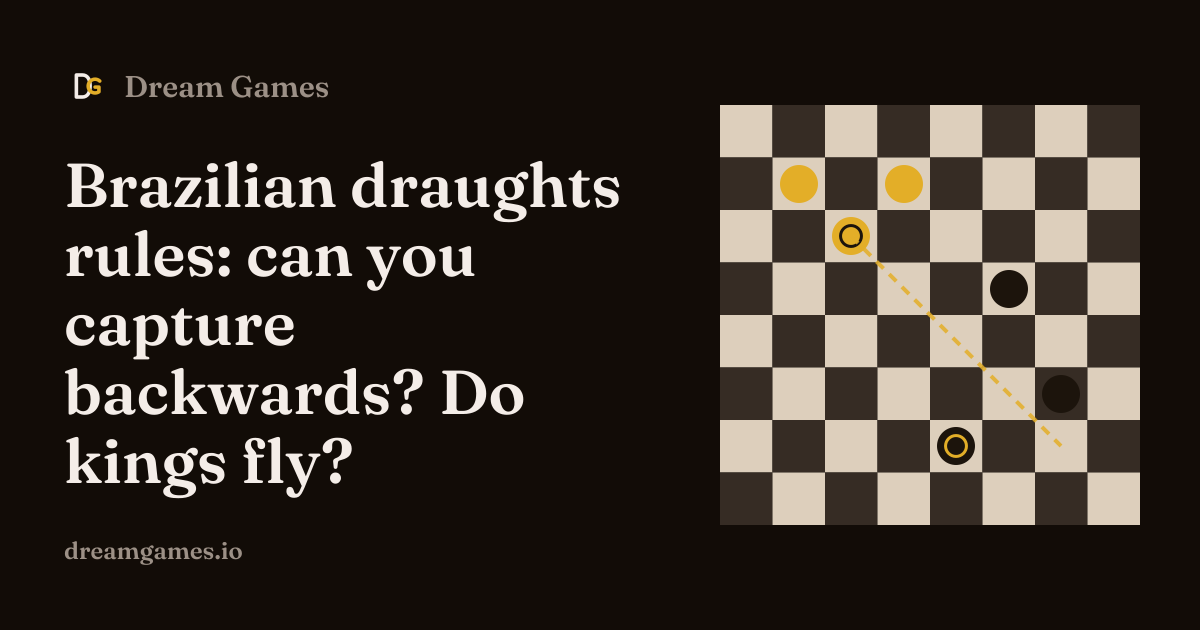
Brazilian draughts is played on the familiar eight by eight board, but with the rules of international draughts: men that capture backwards, kings that fly across the board, and a rule that you must always take the most pieces you can. It is faster and sharper than English checkers, and it is the version of draughts you play on Dream Games, where it is listed as Draughts (8×8).
This article sets out every rule, as the game is played here, and explains how Brazilian draughts differs from its relatives.
The board and the pieces
The board has sixty four squares in alternating colours, and only the thirty two dark squares are used. Each player starts with twelve pieces, called men, on the dark squares of the three rows nearest them. The two middle rows start empty.
White moves first. After that the players take turns, one move each.
How men move
A man moves one square diagonally forward, onto an empty dark square. It cannot move backwards. That much is the same as checkers.
Capturing
Capturing is where Brazilian draughts becomes its own game.
A man captures by jumping over an opposing piece that sits diagonally next to it, landing on the empty square directly beyond. A man can capture backwards as well as forwards. It cannot move backwards, but it can always capture backwards.
If, after landing, the same piece can capture again, it must carry on in the same move, jumping as many times as it can. A sequence of jumps can change direction as it goes.
Capturing is compulsory. If any capture is available, you must make one. You cannot choose a quiet move instead.
The majority rule
When you have more than one capture available, you must choose the one that takes the most pieces. This is called the majority rule, and it is the rule that most often surprises newcomers.
Every captured piece counts the same, whether it is a man or a king. If one sequence takes three men and another takes two kings, you must take the three men. If two sequences take the same number of pieces, you may choose between them.
The majority rule makes Brazilian draughts a game of traps. A strong player will offer you a piece knowing that the rules force you to take it, and that taking it walks you into a larger capture in return.
Removing captured pieces
Captured pieces are not lifted from the board one by one as you jump. They stay where they are until the whole sequence is finished, and only then are they all removed together.
Two things follow from that. A piece you have already jumped still blocks your path, so you cannot land on or pass through its square again. And you can never jump the same piece twice in one sequence. Players call this the Turkish strike rule, and it decides more endgames than you might expect.
Kings
A man that ends its move on the far row, the opponent's back row, becomes a king.
One detail matters here. If a man reaches the back row in the middle of a capture sequence and can carry on capturing, it must carry on, and it continues as a man. It becomes a king only if its move finishes on the back row.
Kings fly. A king moves any number of empty squares along a diagonal, forwards or backwards, like a bishop in chess. It also captures at a distance: it can jump an opposing piece anywhere along a diagonal, as long as the squares between are empty, and land on any empty square beyond it. A flying king can sweep across the board in a single capture, which is why a king in Brazilian draughts is worth far more than a king in checkers.
How the game ends
You win when your opponent cannot move. That happens when all their pieces have been captured, or when every piece they have left is blocked. A player with pieces but no legal move has lost.
Your opponent can also resign, and if their clock runs out, you win on time.
On Dream Games, a game is drawn in two situations:
- The same position, with the same player to move, occurs three times.
- Twenty five moves each, fifty moves in total, are played without any capture and without any man moving. In practice this ends games where only kings are left and neither side can make progress.
Official tournament rules elsewhere use more detailed draw rules for endgames with few kings. The two rules above are the ones the game applies here.
You can also offer your opponent a draw, up to three offers each per game. On Dream Games a drawn game means nobody loses their stake.
How it compares with other draughts
International draughts uses the same rules on a larger ten by ten board, with twenty men each. Brazilian draughts is often described as international draughts on the smaller board, and the skills carry over directly.
English checkers, listed as Checkers (Standard) on Dream Games, uses the same board and the same twelve men, but almost everything else changes. Men capture only forwards, kings move one square at a time, and when you have a choice of captures you may take any of them, not only the largest. If you learned checkers first, the backward captures and the flying kings take a few games to get used to.
Three tips for your first games
- Count captures before every move. The majority rule means your opponent's reply is often forced. Work out what they will have to take.
- Keep your back row while you can. It is the last line against a man becoming a king, and a flying king is hard to contain.
- Do not leave single pieces with an empty square behind them. A man can be captured from behind, so a piece that looks safe from the front often is not.
Where to play
On Dream Games you can play Brazilian draughts free in practice, against a bot on easy, medium or hard or against a friend with a link, with nothing staked and nothing recorded. When you are ready, it is available in the lobby for a stake, in Rivals and in tournaments.
The stake range, the fee and the clock, read from the live settings, are on the Brazilian draughts page, with the tournaments open right now.
The tables are open: play on Dream Games →
All posts