Gomoku strategy: how to win, from open threes to double threats
October 16, 2026
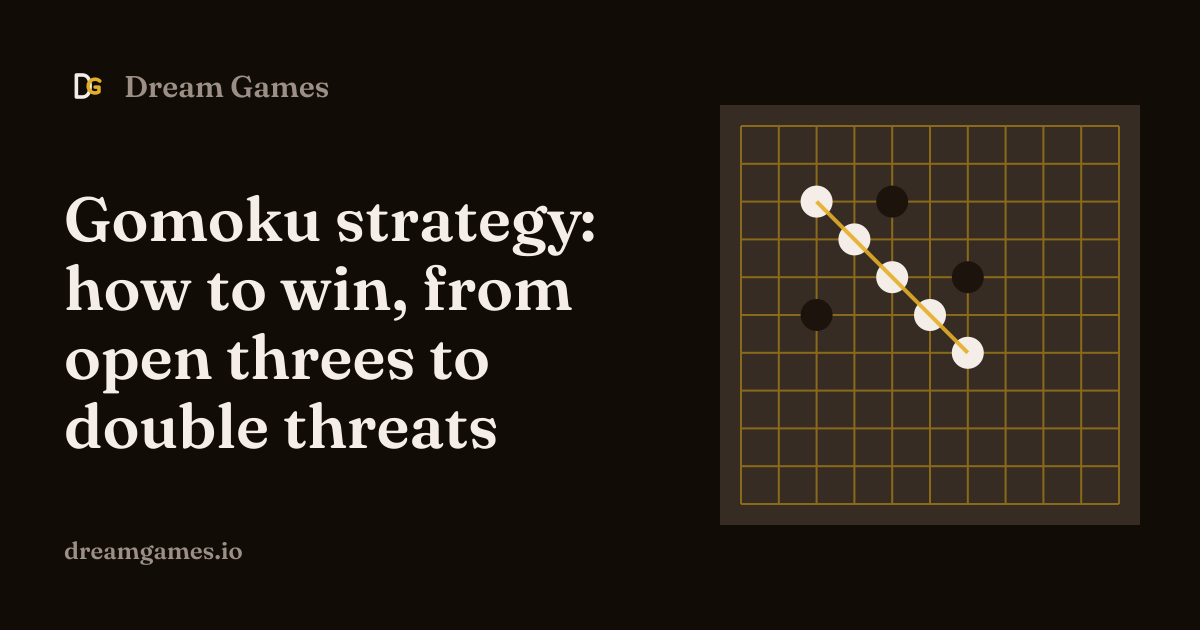
Gomoku looks like a game of luck the first few times you play it: stones appear, a row of five suddenly exists, and the game is over. It is not. Strong players win the same way again and again, and almost every win is built from the same few ideas. This guide sets them out in the order you will need them, with the rules exactly as Dream Games plays them.
The rules this strategy is built on
- The board is fifteen by fifteen, and stones go on the crossing points. A stone never moves and is never captured.
- Five or more in an unbroken row wins, across, down or diagonally. A line of six counts as a win too.
- There are no forbidden moves. Any empty point is legal for either colour, all game.
- The opening is Swap2, and a full board with no five on it is a draw.
That third rule matters more than it looks. Much of the gomoku advice you will find online is written for renju, where black is banned from certain shapes. Here nothing is banned, so every attacking shape below is open to both players.
Learn to read threes and fours
Everything in gomoku is about threats, and threats have names.
- A four is four of your stones in a line that needs one more to make five. Your opponent must block it immediately, on the one point that completes it.
- An open four has both ends free, so there are two ways to finish it. One move cannot block both: an open four on the board is a win.
- An open three is three in a line with room at both ends to become an open four. It must be answered now, because left alone it turns into a win on the next move.
Before every move, look at the whole board and ask two questions. Does my opponent have a three or a four I must answer? Do I have one I can make? Most lost games are lost to a three nobody noticed.
Win with a double threat
A single threat can always be blocked. Two at once cannot. The winning move in most games creates two threats with one stone, so that blocking one lets the other through.
- Four and three. One stone makes a four and an open three at the same time. Your opponent must stop the four, and the three becomes an open four.
- Three and three. One stone makes two open threes. Your opponent can stop only one. In renju this is forbidden to black; here it is legal for both colours.
- Four and four. Two fours at once, in different lines. Neither can be stopped without leaving the other.
The practical skill is preparing the point where two of your lines cross. Build stones that point at the same empty intersection from two directions, then play there when your opponent is busy elsewhere.
Attack with tempo
A four forces a reply. So a run of fours, each one forcing the next block, is a sequence your opponent has no time to interrupt. Strong players look for exactly that: a chain of forcing moves that ends in a double threat. When you have the initiative, keep playing moves your opponent must answer. A quiet move hands the initiative over.
Defend early, and defend with purpose
Block an open three before it becomes an open four, not after. When you block, choose the end that also helps your own stones, so your defence is building something. And watch the points where your opponent's lines cross, because that is where their double threat is coming from. Taking that point first often stops two attacks with one stone.
Play the opening with Swap2 in mind
Without an opening rule, the first player in gomoku has a winning advantage with perfect play. Swap2 takes it away. One player places the first three stones, black, white and black. The other then takes black, takes white, or places two more stones and hands the colour choice back.
So if you are the one placing those first three stones, do not build the strongest position you can find. Build one you would be happy to play from either side, because your opponent picks first. And if you are the one choosing, take the side whose stones are better placed to make threes, not the side that simply has more stones.
Practise it
The gomoku page has the rules in brief, how a game for a stake works, and any open tournaments, and how to play gomoku has the full rules. The fastest way to learn the shapes is to play: practice is free, against a bot on easy, medium or hard or a friend with a link, with nothing staked.
When you play for something, the winner takes 90% of the pot and we keep 10% as our fee, and a draw gives both stakes back in full. Each player has 10 minutes on the clock for the whole game, so spotting a three quickly matters as much as spotting it at all.
The tables are open: play on Dream Games →
All posts