How to play mancala: the rules of oware, step by step
October 16, 2026
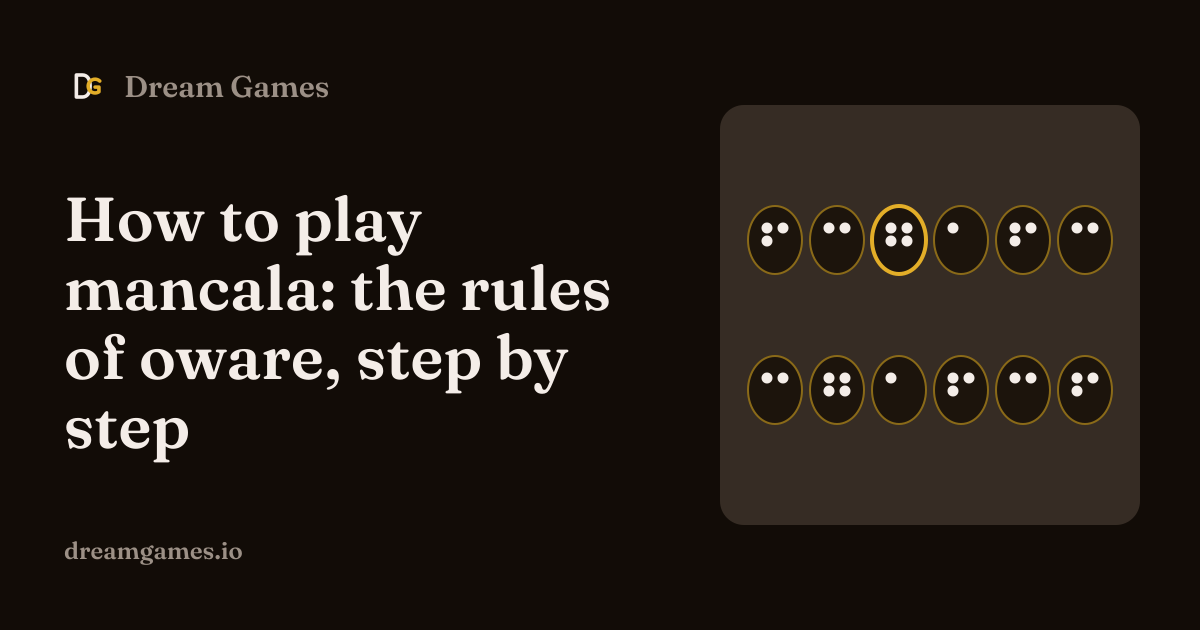
"Mancala" is not one game. It is the name of a whole family of sowing games, played with seeds or pebbles in rows of small pits, from West Africa to the Caribbean to Southeast Asia. If you learned a mancala game as a child, it was most likely Kalah, the boxed version with a big store at each end. The mancala played on Dream Games is oware, the version played across Ghana, Nigeria and the wider West African world, and its rules are different in ways that matter. This guide teaches oware from the beginning, then shows where it parts company with Kalah, so you do not carry the wrong habits onto the board.
The board
An oware board has two rows of six pits, called houses. The row nearer you is yours and the far row belongs to your opponent. Every house starts with four seeds, forty-eight in all. There are no stores: the seeds you capture come off the board and are counted beside it.
Sowing: how a move works
On your turn, pick one of your houses that has seeds in it, scoop up every seed, and drop them one at a time into the houses that follow, moving anticlockwise. The sowing runs through your opponent's row as well as your own, round and round. If a house holds enough seeds to go all the way round the board, the house you emptied is skipped: it stays empty, and the sowing carries on into the next one.
Capturing
Only the last seed of a move can capture. If it lands in one of your opponent's houses and brings that house to exactly two or three seeds, you take them. Then look at the house just before it: if that one also holds two or three, you take those too, and so on backward along your opponent's row, until you reach a house that does not, or the end of their row. One move can sweep up several houses this way.
A last seed that lands in your own row never captures, and neither does one that leaves a house holding one seed, or four or more.
Feeding your opponent
Oware has fairness built into it. If your opponent's row is empty and you have a move that gives them seeds, you must play one. And a capture that would take every seed on your opponent's side may be played, but it captures nothing: the seeds stay where they are and the game goes on. You can squeeze an opponent, but you cannot starve them out.
How the game ends
The first player to capture twenty-five seeds wins, because twenty-five is more than half of forty-eight and nobody can catch up. Twenty-four each is a draw.
A game can also end before anyone gets there: when a player has no move, when the same position comes round again, or when the game goes on too long without a capture. Then each player takes the seeds on their own side, and the totals decide it. Having no move is not a loss in oware. Only the seeds count.
Oware is not Kalah
If your mancala is Kalah, these are the habits to leave at the door:
- There are no stores. Sowing never drops a seed into a pit of your own at the end of the row, because there is no such pit.
- There are no extra turns. Every move is answered by your opponent, wherever your last seed lands.
- You never capture by landing in an empty house on your own side. Captures happen only in your opponent's row, and only on a count of two or three.
- The game does not end just because one row runs dry. Your opponent must feed you if they can.
Those are the rules Dream Games plays. The board does the counting for you, so a capture chain or a skipped house is never something you have to work out by hand.
A few first tips
- Count before you sow. The whole game is arithmetic: how many seeds are in the house, and where will the last one land?
- Watch the houses on your own side that hold one or two seeds. Those are the ones your opponent can turn into a two or a three.
- A house that has quietly piled up a lot of seeds is a weapon. Sown at the right moment, it goes all the way round and can land on a row of small houses.
- Do not race to empty your opponent's side. The feeding rule means you will often have to give the seeds straight back.
Play it
The mancala (oware) page has the rules in brief, how a game for a stake works, and any open tournaments. For the full rules in one place, read how to play oware. Practice is free: play a bot on easy, medium or hard, or send a friend a link, with nothing staked and nothing recorded.
When you want to play for something, both players put up the same stake, the winner takes 90% of the pot and we keep 10% as our fee, and a draw gives both stakes back in full. Each player has 10 minutes on the clock for the whole game.
The tables are open: play on Dream Games →
All posts