How to play Chess
August 18, 2026
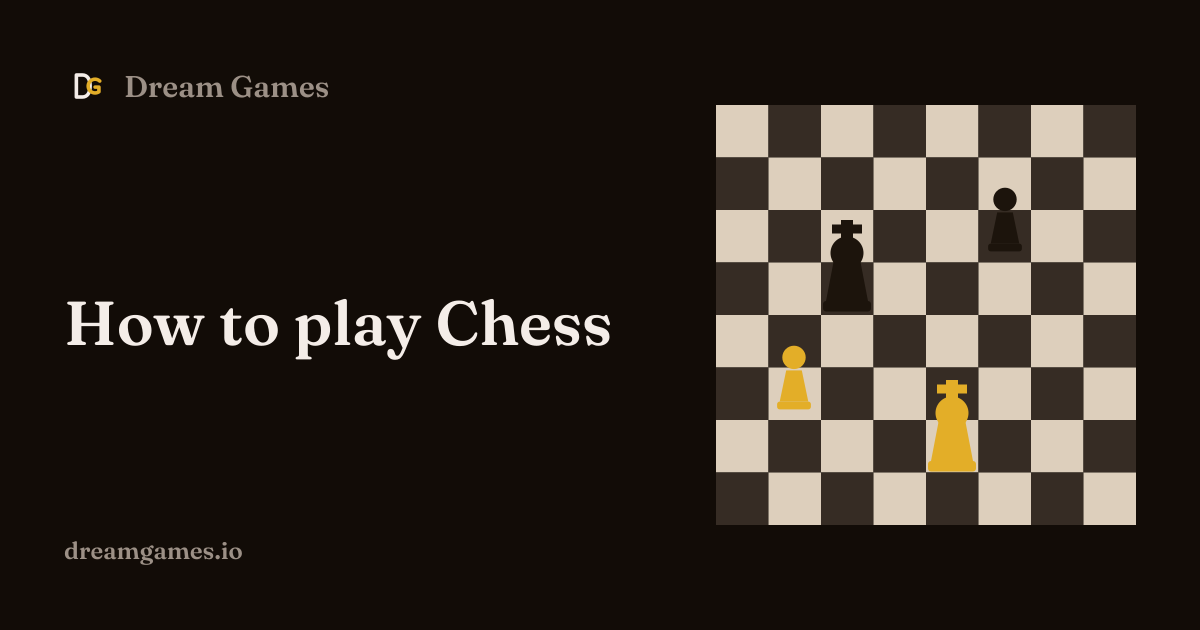
Chess has been played for about fifteen hundred years, and it still fills more boards than any other game on earth. Two small armies face each other with no dice and no luck, so nowhere to hide. Everything that happens on the board is something you or your opponent chose. That is the whole appeal.
The board and the pieces
The board is an eight by eight grid of light and dark squares. You start with sixteen pieces: eight pawns, two rooks, two knights, two bishops, a queen, and a king.
Each piece moves in its own way. Rooks slide along rows and columns. Bishops slide along diagonals. The queen does both, which is why she is the strongest piece. Knights jump in an L shape, two squares one way and one square sideways, and they are the only piece allowed to jump over others. Pawns walk forward one square at a time (two if it is their first move) and capture one square diagonally. The king steps one square in any direction.
White moves first, then you take turns, one move each. You capture a piece by landing on its square. Captured pieces are gone for the rest of the game.
How you win
You win by checkmate. When a king is under attack, that is called check, and the player in check must deal with it at once. If there is no way to deal with it (the king has no safe square, nothing can block the attack, and nothing can capture the attacker), that is checkmate, and the game is over.
There are two other ways to win. Your opponent can resign. And if their clock runs out, you win on time, whatever the position looks like.
The rules that matter
A few special rules come up in real games, and they all work here exactly as they do in the official rules of chess.
Castling. Once per game, if the squares between them are empty and neither piece has moved, your king slides two squares toward a rook and the rook hops to the other side of him. It is the only move where two of your pieces move at once, and it is the usual way to tuck your king somewhere safe.
Promotion. A pawn that walks all the way to the far end of the board becomes a queen. Over a real board you could choose a rook, a bishop or a knight instead; here it always becomes a queen.
En passant. A French phrase meaning "in passing". If an enemy pawn uses its two square first move to rush past one of your pawns, you may capture it on the very next move as if it had only moved one square. Miss that chance and it is gone.
Draws. Some games have no winner, and on Dream Games a drawn game means nobody loses their stake. A game is drawn when any of these happens:
- Stalemate. The player to move has no legal move at all, but their king is not in check.
- The same position appears three times. Nothing is going anywhere.
- Fifty moves pass in a row with no capture and no pawn move.
- So little material is left that checkmate is impossible, for example a lone king against a king and one bishop.
You can also agree to a draw. Either player can offer one, up to three offers each per game, and if your opponent accepts, the game ends there.
How a match works on Dream Games
Both players put up the same stake, and both stakes are set aside before the first move. The winner takes 90% of the pot and we keep 10% as our fee. If the game is a draw, both players get their stake back in full and we take nothing.
Each player has 10 minutes on the clock for the whole game. Your clock only runs while it is your turn. Run out of time and you lose, even if you are ahead on the board.
Try it
The best way in is simply to play. Practice is free: pick a bot on easy, medium or hard, or send a friend a link. Nothing is staked and nothing is recorded, so you can experiment as much as you like.
When you are ready to play for something, find an opponent in the lobby. You see the stake and the payout before you accept, and nothing leaves your balance until you say yes.
The tables are open: play on Dream Games →
All posts