How to play Hex
August 18, 2026
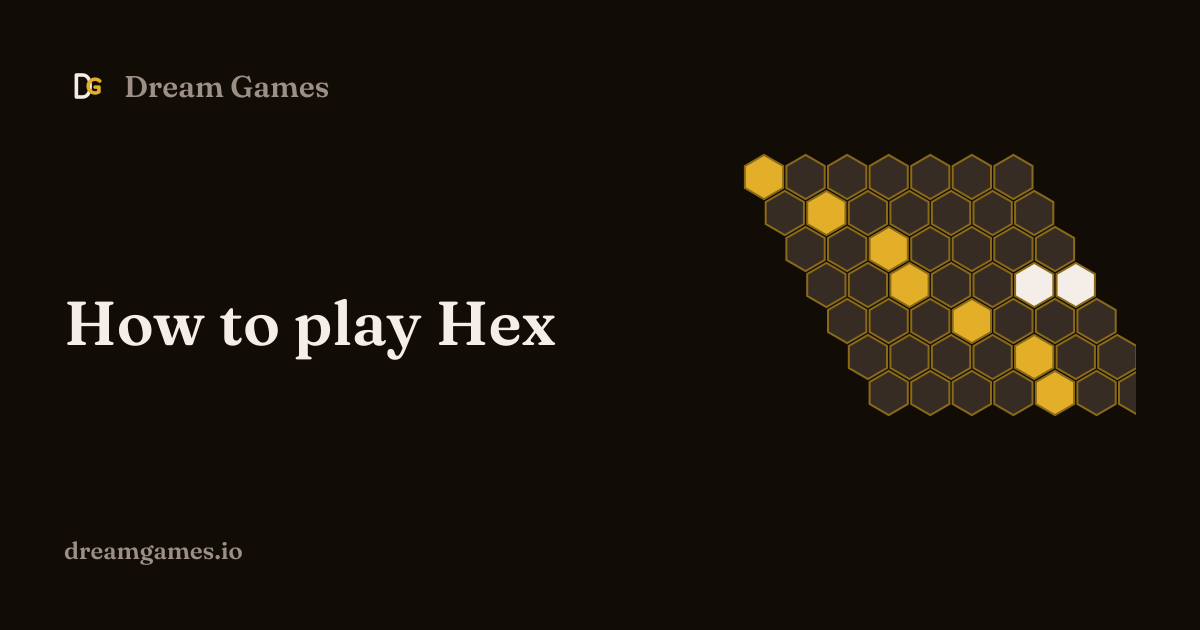
Hex was invented twice, independently, by two people who thought hard for a living: the Danish designer Piet Hein in 1942, and the mathematician John Nash a few years later. That double birth tells you what kind of game it is. One rule, one kind of move, and a promise you can actually prove: somebody always wins.
The board and the pieces
The board is an eleven by eleven diamond of hexagonal cells. Red owns the top and bottom edges, Blue owns the left and right. On your turn you place one stone of your colour on any empty cell. Stones never move and are never captured. The four corner cells are shared: each one touches both players' edges, and counts for both.
How you win
Build an unbroken chain of your own stones connecting your two edges: Red from top to bottom, Blue from left to right. The first finished chain wins, and one always arrives. Because the cells are hexagons, the two chains cannot cross each other without touching, and that is why a drawn game of Hex is impossible. Your opponent can also resign, and if their clock runs out, you win on time.
The rules that matter
The swap rule. Going first is a huge advantage, so Hex balances it with a steal. Red places the first stone of the game. On the second move, Blue has a choice: reply normally, or take over Red's opening stone. If Blue takes it, the stone is lifted off the board and reappears as a Blue stone on the mirrored cell across the long diagonal. So do not open with your best move. Open with a move you would not mind handing over.
After that, nothing changes hands. The swap can only happen on move two, colours never change again, and play simply alternates, one stone at a time, until a chain is finished.
No draws from play. Someone always connects: it is a mathematical fact about the board, not a house rule. The only way a game ends without a winner is if both players agree to call it off, and in that case both stakes are returned in full and we take nothing.
How a match works on Dream Games
Both players put up the same stake, and both stakes are set aside before the first move. The winner takes 90% of the pot and we keep 10% as our fee. A game of Hex always produces a winner from play, so the only draw is the one you both agree to, and that returns both stakes in full.
Each player has 10 minutes on the clock for the whole game. Your clock only runs while it is your turn. Run out of time and you lose, even if you are ahead on the board.
Try it
The best way in is simply to play. Practice is free: pick a bot on easy, medium or hard, or send a friend a link. Nothing is staked and nothing is recorded, so you can experiment as much as you like.
When you are ready to play for something, find an opponent in the lobby. You see the stake and the payout before you accept, and nothing leaves your balance until you say yes.
The tables are open: play on Dream Games →
All posts